
Paying the penalty does not close a violation. The cited condition must be corrected, and the required Certificate of Correction must be accepted by the appropriate agency. We handle the repair work, correction documentation and filing support so an open summons does not remain unresolved simply because the fine was paid.
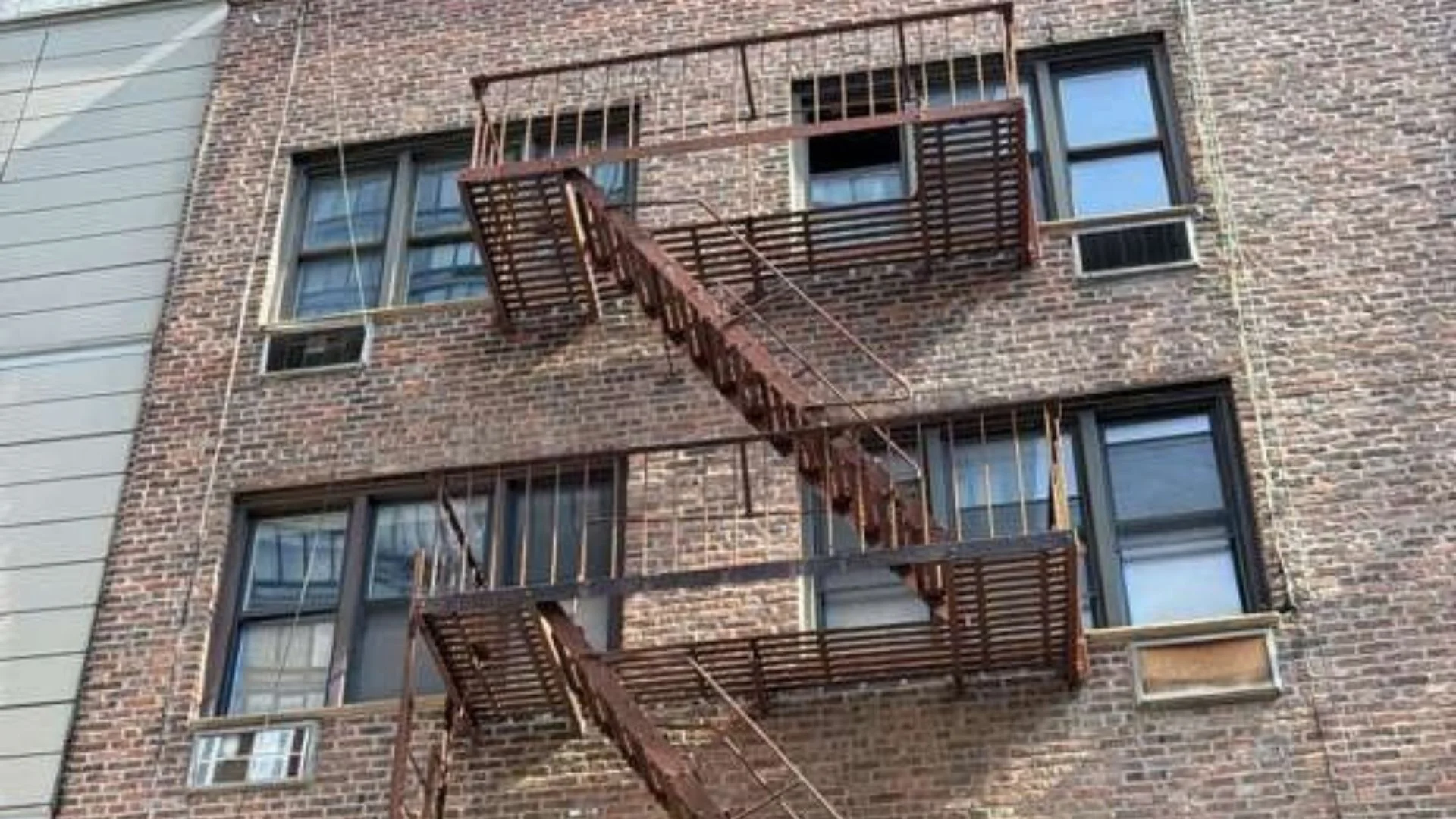
Older buildings are particularly vulnerable to corrosion. Years of moisture exposure can cause section loss, weakened connections, deteriorated coatings and damaged steel. A violation may identify one specific component rather than the entire structure. Corrective work therefore needs to address the condition actually cited.
A fire escape cannot function properly as an emergency egress route if it has become a storage area. Furniture, planters, grills, boxes and other belongings can interfere with access or safe movement. For an obstruction violation, we document the corrected condition as part of the closeout process.
Treads, platforms, railings, brackets and connections can deteriorate over time. A weakened support requires more than surface preparation. The repair must address the component identified in the summons and restore it to a sound condition. Where welding, component replacement or connection repair is required, we match the work to the cited defect and applicable requirements.

The first question after receiving a summons is which agency issued it. DOB/OATH and FDNY have different correction procedures, deadlines and certification requirements. Treating them as the same process can result in an incorrect filing or missed deadline.
Older records may refer to the Environmental Control Board (ECB). Administrative hearings are now handled through the Office of Administrative Trials and Hearings (OATH).
Paying a civil penalty does not automatically clear the violation. The condition must be corrected and acceptable proof of correction submitted. For DOB violations, Certificate of Correction requests are submitted through DOB NOW: Safety. DOB also states that civil penalties must be paid or waived before a Certificate of Correction can be approved.
FDNY violations follow a separate correction route. The Fire Department states that the cited condition must be corrected and proof submitted through its own process. A Certificate of Correction generally must be received within 35 days from the violation date to avoid a penalty and hearing.
FDNY correction requests are submitted through FDNY Business, rather than DOB NOW: Safety. The distinction matters. A DOB filing cannot simply substitute for an FDNY correction, and vice versa.
Immediately hazardous and requires immediate correction.
Major violation, generally requiring correction and certification within 40 days.
Lesser violation, generally requiring correction and certification within 40 days.
First, we address the physical condition identified in the notice. That can include removing corrosion, repairing damaged steel, welding compromised components, securing brackets, repairing railings or treads, replacing deteriorated sections or removing an obstruction. We work from the actual violation language rather than assuming a general refurbishment will satisfy the agency.
After the physical work is complete, the appropriate certification must be submitted. For DOB/OATH matters, the Certificate of Correction process is handled through DOB NOW: Safety. DOB requires applicable civil penalties to be paid or waived before approval. For FDNY matters, the correction follows the Fire Department's separate submission process through FDNY Business.
Paying a penalty does not automatically erase the underlying violation. For DOB records, an unresolved violation can continue to appear open until acceptable proof of correction is submitted. Certain violations can also lead to additional enforcement when correction is not properly certified.
An open record can become a practical concern during property due diligence. Buyers, lenders, managing agents and insurers may ask about unresolved violations during a sale, refinance or insurance review. If you paid an old fine but the violation still appears open, determine which agency issued it, what condition was cited and what certification remains outstanding.
We handle the physical correction work required by the notice. Depending on the cited condition, this may include:
The objective is to correct the condition identified by the agency and leave the structure properly documented for closeout.
A successful correction submission needs evidence that demonstrates what was corrected. We can organise before-and-after photographs, dated project records, repair details and other supporting documentation relevant to the certification.
For DOB matters, supporting evidence may include photographs, permits, receipts and other proof of correction depending on the violation. For FDNY matters, the Department similarly reviews documentation supporting the claimed correction.
Once your violation is cleared, we can also help with your fire escape compliance and certification. If your summons relates to a façade inspection or FISP issue, see our Local Law 11 / FISP compliance guide.
We handle correction projects across Manhattan, from older tenement and pre-war apartment buildings to brownstones, lofts, mixed-use properties and larger residential buildings.
Our service area includes Harlem, Washington Heights, Inwood, Morningside Heights, Upper West Side, Upper East Side, Midtown, Hell's Kitchen, Chelsea, Flatiron, Gramercy, Murray Hill, East Village, West Village, Greenwich Village, SoHo, NoHo, Tribeca, Lower East Side, Financial District, Battery Park City and Roosevelt Island.

No. Paying the penalty does not by itself certify that the cited condition was corrected. For DOB violations, an acceptable Certificate of Correction must be submitted and approved. FDNY summonses similarly require correction and proof submitted through the Fire Department's process.
They follow different agency procedures. DOB/OATH matters use the Buildings correction process and DOB NOW: Safety. FDNY summonses use the Fire Department's own Certificate of Correction process. Always follow the agency and deadline shown on the actual notice.
It depends on the violation. DOB Class 1 violations require immediate correction. Class 2 and Class 3 violations generally have a 40-day correction and certification period. For FDNY summonses, the Fire Department generally requires the Certificate of Correction within 35 days of issuance.
An obstruction is a condition that interferes with access to or use of an emergency egress route. Furniture, planters, storage items, grills and similar belongings may create an issue when left on the structure.
Yes. A submission can be rejected when the evidence does not adequately demonstrate correction or required information is missing. For DOB, applicable civil penalties must also be paid or waived before approval.
Yes. We handle the physical correction work and organise the supporting documentation needed for the certification process. The exact filing route depends on the agency, summons and project circumstances.
Resolving an open violation can make property due diligence easier because the cited condition is no longer unresolved in the agency record. However, clearing one summons does not guarantee that the property has no other outstanding violations.
We can review the notices together, identify the agency, classification, cited condition and deadline, then determine which repairs can be completed as one project. This can be particularly useful when several related components need correction during the same mobilisation.
Have an open summons, a paid penalty with an unresolved record or a correction deadline approaching? Don't assume the fine closed the matter. Let us review the notice, identify the cited condition and determine what needs to happen to get the correction properly documented and submitted.
Clear Your Fire Escape Violation Today →